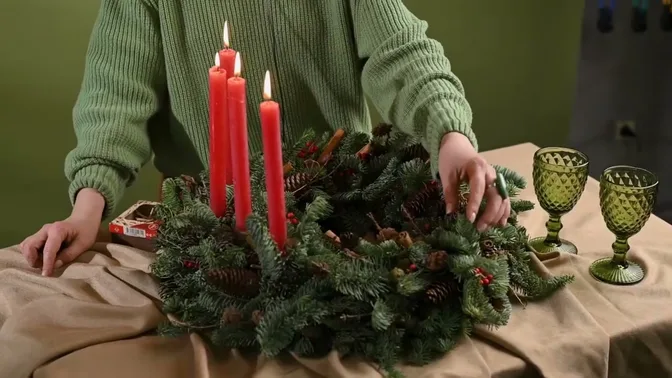
Start with a place for your Christmas wreath. A door wreath needs a hanging arrangement and a clear front; a tabletop wreath needs room around it. A branch wreath on a stand and a woven wreath bowl have their own supporting structures.
The main material determines how much of the structure you will see. Overlapping evergreen sprigs hide the base in green. Pinecones create a deeply textured surface. Bare branches leave gaps through which you can see the background. Dried flowers can form a generous accent on one side while the vine remains exposed. Plan the decoration around that surface.
Choose a place before choosing decorations
Where it will go | Projects to consider | What to plan |
|---|---|---|
Door or wall | Classic fir, velvet-ribbon evergreen, open branch wreath | Hanging arrangement, side profile, projecting details, and the back |
Table | Tabletop evergreen or pinecone wreath | The full spread of branches and room for place settings |
Its own stand | Apple-branch wreath | Wooden support, metal uprights, and connections to the frame |
A centerpiece on the table | Woven wreath bowl with dried flowers | Bowl height, stem, and decoration around the rim |
Measure the space for the finished branches, not just the bare ring. For a hanging design, consider how the wreath will attach to the particular door or wall as well as how its own loop is made. An interior vine wreath with a large side arrangement also needs a position that lets you see its depth.
Evergreen wreaths: three ways to shape the greenery
Classic fir with a full, continuous outline
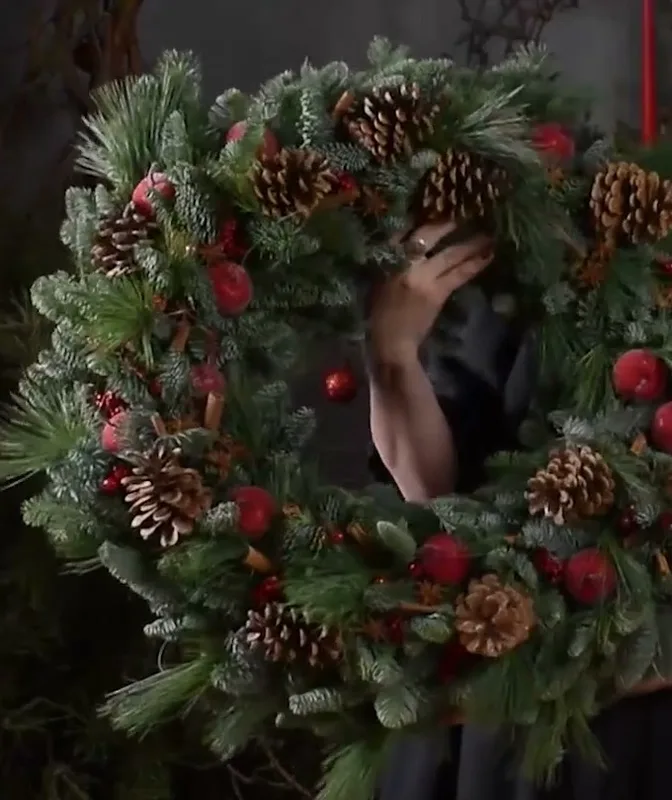
In the classic fir Christmas wreath, small sprigs overlap on a hay base. Each layer covers the wire holding the previous one. At the end, the last sprigs tuck beneath the first, closing the circle without an obvious break. Pinecones, nuts, cinnamon, and gold accents follow the direction of the foliage.
For a rounded, substantial green shape, keep the covering even all the way around. A thin patch or a bulky section will affect the outline before you add any decorations. Fabric covers the back, where a wire hook is attached.
Our Classic Fir Christmas Wreath step-by-step video follows this exact project. It is a useful continuation if you want a close view of the overlapping layers, the final join, and the back finish.
See the videoMixed greenery, from the base to the decorations

The base-and-decoration project starts with the underlying form. It considers a ring cut from polystyrene, a tightly bound hay or straw ring, and a circle formed from flexible branches. Choose the structure together with the way you will fasten the materials.
The evergreen covering combines compact fir foliage with looser pine sprigs. Larger decorations sit in groups, leaving some of the greenery exposed. Pinecones, cinnamon, star anise, and red accents give the wreath its Christmas character without covering every part of the foliage.
Notice the inside edge as you plan a full wreath. Greenery adds volume inward as well as outward, so oversized sprigs can crowd the opening. The free fresh evergreen wreath guide is a separate practical starting point for working with foliage and a ring base.
A door wreath with velvet ribbon

The velvet-ribbon wreath uses mixed greenery as a background for an asymmetrical arrangement. Larger accents gather near the bow; smaller details taper along the decorative line. The ribbon tails carry that movement downward.
The prominent bow gives the wreath a clear front. Try laying out the decorations before gluing them, then look at the wreath upright. Ribbon tails behave differently when the wreath lies flat. In this project, the hanging loop is added before the fragile decorations, reducing the need to turn the decorated wreath over.
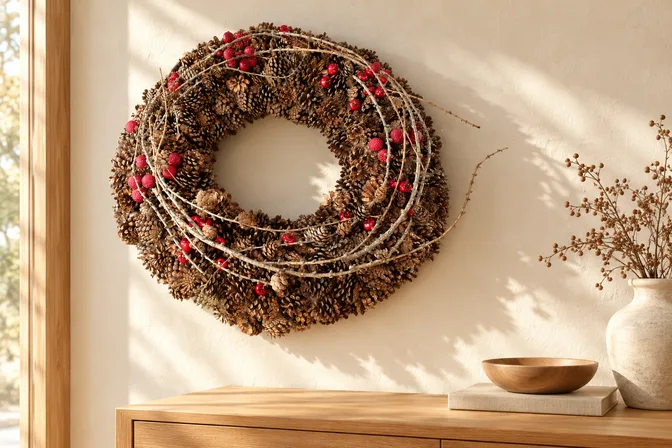
Pinecones cover the ring in deep texture
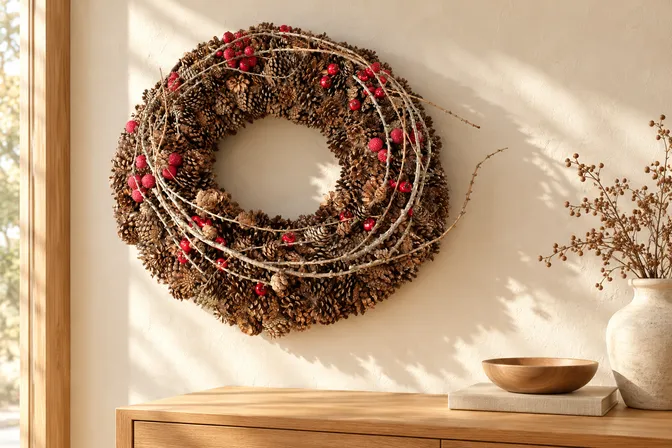
The natural pinecone Christmas wreath has a surface built mainly from the cones themselves. Each cone receives its own wire attachment, with the wire ends inserted into a hay ring. Small pieces of felt cover gaps where the base still shows. Larch branches run across the cone surface and repeat the circular movement.
Choose it for the layered scales and natural brown tones, with small ornaments as accents. You will prepare many individual attachments before adding the smaller decorations. Set aside broken or crumbling cones as you sort; they are difficult to secure intact.
This project allows either a wall display or a tabletop setting. Decide which you want early, so you can plan the main view and the reach of the branches. The pinecone wreath guide introduces the construction. For the complete process of this particular design, see our Natural Pinecone Christmas Wreath video.
See the videoA tabletop evergreen wreath needs room around it
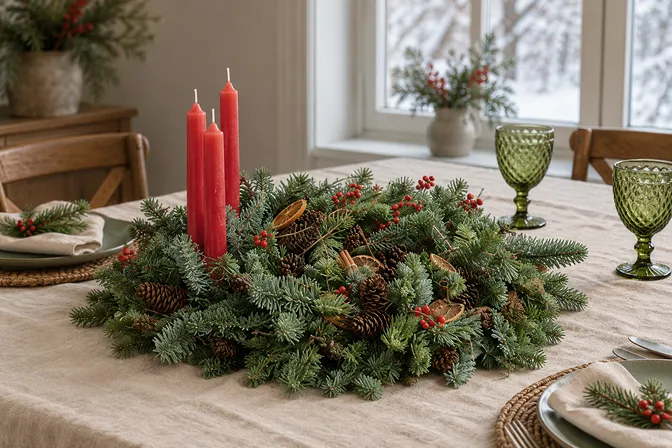
The tabletop evergreen wreath with natural decorations is designed to share the table with people and place settings. Projecting branches are trimmed to keep the arrangement within its space. Larch branches bring small cones into the greenery, followed by dried citrus, cinnamon, and berry accents.
Mark out the intended area on the table before you start. The foliage will extend beyond the ring, and decoration can increase that spread again. If you like a quiet, natural look, let the greenery show between a few groups of accents.
Slender candles are part of this design and have wire supports. Their presence does not establish that the wreath is suitable for an open flame. Use flameless candles when you want light among the plant materials.
A wild, projecting edge that looks appealing on a wall may take up space needed for dinner when the circle lies on the table.
Open branch forms: a hanging circle or a separate stand
Two branch wreaths with a star and natural accents
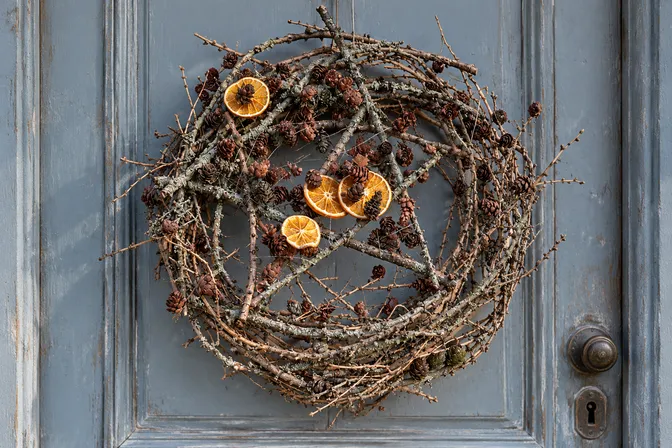
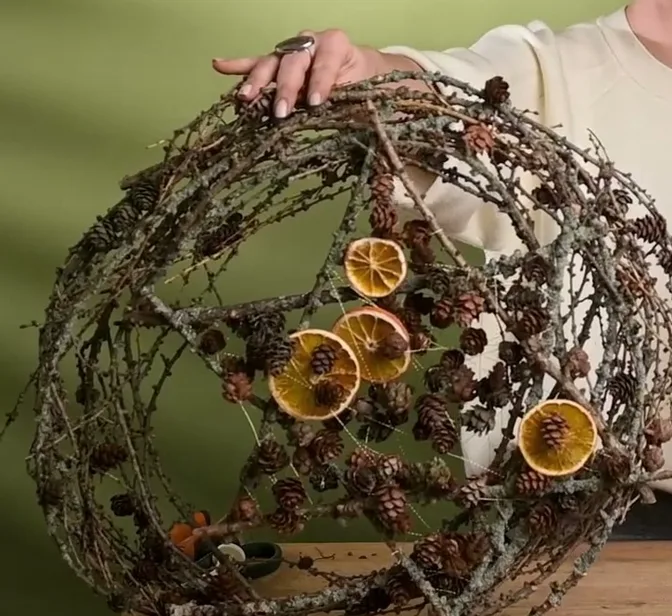
An open branch wreath lets the background show between its lines. Curved branches overlap to form the circle, then more branches build volume inside and outside it. Some wire connections hold branches a little apart, preserving gaps instead of binding everything into a dense bundle.
Two decorating variations show how much the same construction can change. One includes a star made from two triangles of straight twigs; the other has a quieter natural finish. Small cones, dried citrus, and a little evergreen foliage add detail while leaving the branch pattern visible.
Match the branches to the shape. Test a few against the intended circle before preparing the whole bundle. Straight pieces suit the star, while the ring needs curves and flexibility. Trim and bend down wire ends as you go so they do not disappear between the branches with sharp ends exposed.
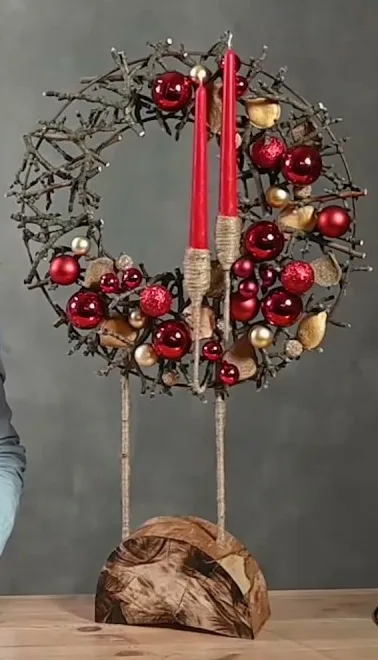
An apple-branch wreath on its own stand

The apple-branch project has a different structure: two wire circles, one smaller and set off center, joined by connecting wires. Branches cover the frame and reach through its plane to give it depth. Red and gold accents form a crescent around part of the circle.
The wreath stands upright on a wooden support fitted with metal uprights. The base and its connections to the frame are part of the project from the beginning. Consider this design if you want a separate interior piece and enjoy working on a wire structure. Build the support with the frame, before adding branches and decorations.
The two candles attached at the side are decorative only. Do not light them.
Dried flowers: an accent on vine or a woven wreath bowl
Virginia creeper with a full arrangement on one side

In the interior dried-flower wreath, the vine remains part of the visible design. A large dried-flower arrangement occupies one section of the circle. Loose fern fronds sit beside smooth corn leaves, with a lotus pod drawing attention to the fuller area.
This amount of material needs more preparation than a small tied bundle. The project uses dry floral foam, fastened to the vine with paper-covered wire and short supporting twigs that keep the wire from cutting into the foam. The arrangement extends out from that foundation.
Choose this direction if you like the natural line of the vine and want to leave part of the ring exposed. Step back while arranging: the large accent can look balanced close up and dominate the whole circle from farther away. Grouping small details helps them remain visible beside larger forms.
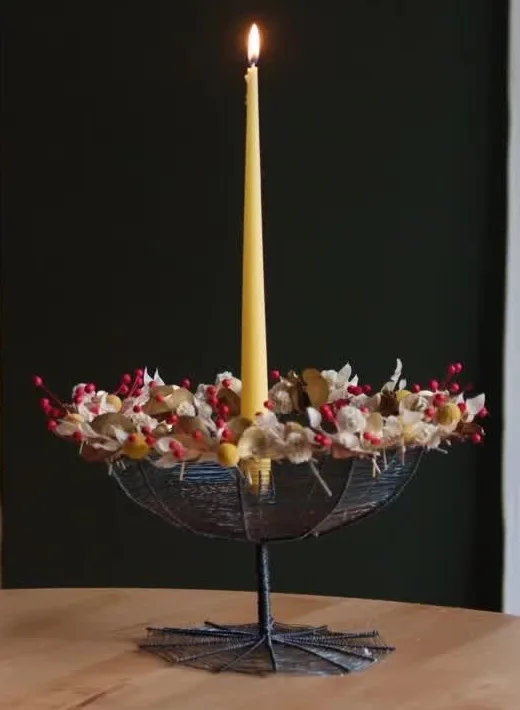
A woven candleholder with a dried-flower wreath bowl
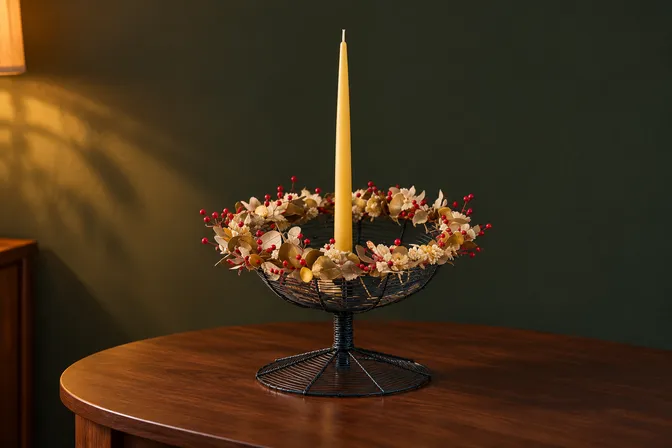
Here the wreath shape becomes the rim of a three-dimensional bowl. The foot, stem, central candleholder, and outer bowl are woven from wire. Dried flowers and gold-colored eucalyptus decorate the edge while gaps in the wirework remain visible.
Building the tabletop bowl takes time before any decoration goes on. Choose it for the weaving itself and the open wire form if you are happy to spend time on repeated handwork. The bowl comes before the decoration. A more open weave gives the wire pattern a different appearance from tightly spaced rows.
A candle is part of the central holder's shape. Use a flameless version for light among the dried materials.
Match the base to the work you want to make
A hay ring provides the body for the evergreen wrapping and the individual wired pinecones in these projects. In the open branch wreath, the branches themselves form the circle. The apple-branch design depends on a separate wire frame and stand. The wreath bowl requires building the entire three-dimensional form.
Before gathering supplies, decide where the finished piece will go and what will form its main surface. Check how that material attaches to the base. Keep the fuller construction instructions for the project you choose. The finishing and hanging guide covers a separate part of the process; the Christmas and Winter Floristry collection offers other seasonal forms if a wreath does not suit your space.