For a dining table, start with a low arrangement that leaves room for place settings. A long console can accommodate a line of branches, while a separate side table gives a tall ring, crescent, or wooden structure room to stand out. Decide on the place and outline first. Then choose whether the main material will be flowers, dense greenery, open branches, or a living plant in a container.
Red, blue, and gold decorations change the mood. The finished size and structure still determine where the arrangement can go. Two arrangements in the same colors may have very different heights, spreads, and supporting structures. Different materials can also share a similar outline and keep its character.
Check the space from the position where you will see it
Set an empty container or base on the intended surface. Look at it from your chair, the doorway, or the sofa. Allow for the flowers and branches that will extend beyond the container. At a dining table, sit opposite someone and check where an arrangement would begin to interrupt the view.
Location | A direction to consider | What limits the choice |
|---|---|---|
Dining table | Compact round or low elongated arrangement | Place settings, sightlines, and projecting branches |
Long table, console, or shelf | Flower-filled box, open board arrangement, branch framework | Finished spread, shelf depth, and viewing direction |
Separate side table or interior display | Wooden candleholder, raised ring, crescent | Height, support, and space around the whole form |
A gift with a living plant | Orchid in glass or amaryllis planter | Plant size, container, and access for care |
A low container does not guarantee a low finished arrangement. Flowers, candles, or a raised framework can take it well above the rim. Choose a place for the whole object.
Compact circles: a filled container or a tabletop wreath
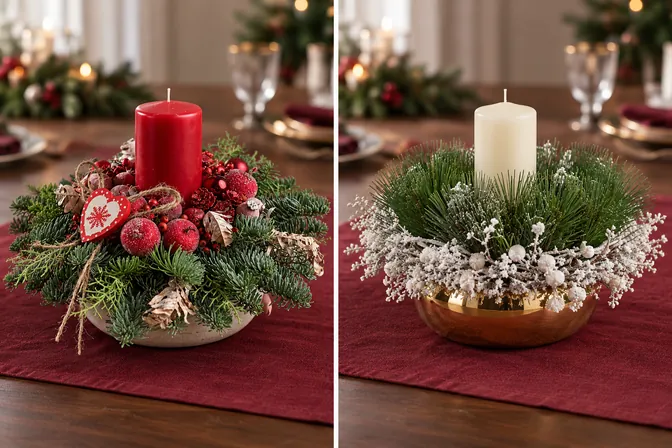
In the round arrangement with a red candle, dense evergreens surround one central accent. Red decorative apples, ornaments, and berry details gather in groups; smaller pieces fill the gaps. This gives a contained shape with a strong center of color. Keep the outline even and cover the floral foam that holds the stems and decorations.
The pine-sprig arrangement with white decorations builds its surface differently. Small bunches of pine receive individual wire attachments and wrapped bases before they cover the foam projecting above the container. White cones, ornaments, and snowy branches form a band around the edge. Choose this look if you enjoy repeated pine tufts and a pale decorative rim. Each bunch needs preparing before installation.
For a circle with an open middle, consider the tabletop evergreen wreath with natural accents. Its ring outline gives it a different presence from a filled bowl, though projecting branches still add to the space it occupies. The Christmas wreath selection guide compares wreath structures and coverings in more detail. Decide whether you want a filled center or a ring on the table.
For a small space, the separate guide to size, silhouette, and containers looks more closely at the choice between a low and an upright arrangement.
Asymmetry needs room for the longer side
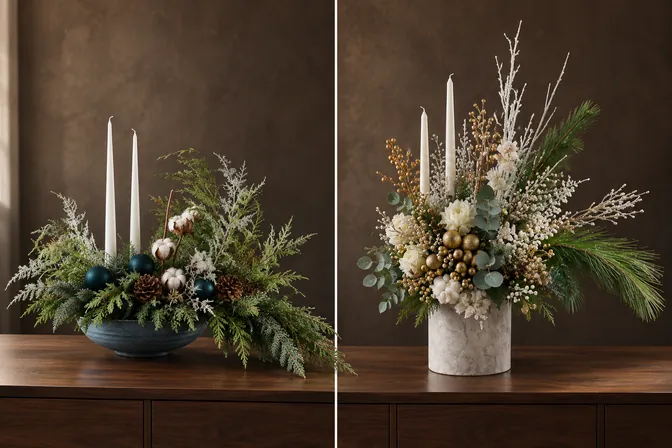
An asymmetrical arrangement needs a free side for its branch line to continue. Check that space before choosing a vessel. A long extension may reach over a plate on a small table; on a console, the same curve can give the arrangement its outline.
The blue Christmas arrangement uses spreading juniper branches to shape the contour above a wide, shallow dish. Denser evergreens cover the foam at the center. White cotton and blue ornaments create a transition from light patches to deeper color, with two candles grouped opposite the main extension. The full center sits beside an open evergreen line. Large decorations spaced evenly along that line would make its curve harder to see.
The white-and-gold interior arrangement takes a fuller floral approach. Pine forms the long extension; large flowers and ornaments establish the main groups, with smaller elements at different levels. White moves through creamy shades toward gold and yellow. Choose this direction if you want both flowers and greenery to remain visible. Allow space for the substantial floral group as well as the long side. The layers give the arrangement depth instead of one flat surface of decoration.
In either case, decide which view matters most. A long side that looks balanced from the front may reach beyond the available surface at an angle. Move the empty container and a few loose branches around before you commit to the final position.
Long surfaces: a flower-filled box or an open branch line
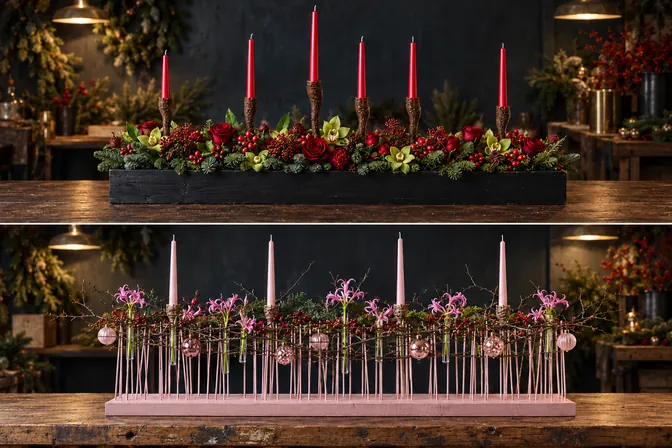
A rectangular box sets a clear boundary for a low mass of flowers and evergreens. The Christmas box arrangement combines red roses, small orchid flowers, skimmia, and berries, with greenery kept low and candles rising above it. A liner protects the nonwatertight box before wet floral foam goes inside. Prepare the box to hold wet foam before arranging the fresh flowers.
The box brings the color and fullness of flowers along a table. Plan the final spread beyond the edges of the box, and look at the arrangement from both seated positions. The box provides a starting outline; the inserted materials determine how much space it ultimately takes.
An open arrangement on a board leaves more gaps in the structure. Upright bamboo skewers are fixed into the board, with graphic branches secured between them. Some of the greenery is removed to keep the branch lines visible. Fresh nerine flowers sit in individual water tubes, while woven candle cups and ornaments repeat along the base. The lower space stays open instead of being covered with dense foliage.
Choose it for the visible branchwork above the surface. It involves a construction stage before the flowers: drilling, installing uprights, and weaving holders. Allow for branches beyond the board's ends when planning its length. Building this framework takes different preparation from filling a box with flowers.
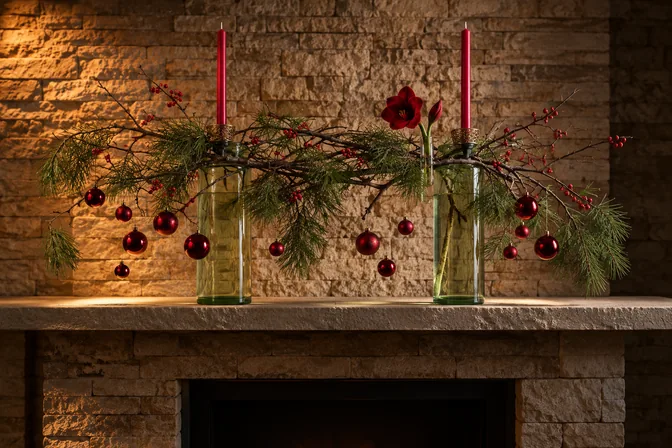
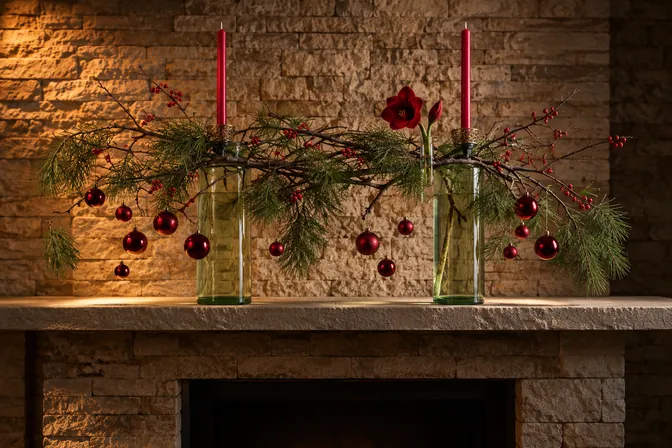
For a mantel or console, a third approach connects two tall vessels with a branch framework. In this interior design, greenery and suspended ornaments trail down, and an amaryllis flower has its own water tube. The high supporting points and the line between them replace a continuous, dense mass. Measure shelf depth as well as length, including room for trailing details. A mantel setting also needs consideration of the actual conditions around the fireplace; the floral construction does not establish suitability beside a working fire.
Tall interior pieces start with their supports
The base remains visible in these tall arrangements. You can leave wood exposed, raise a ring above a container, or build a separate sculptural form. These pieces are easier to enjoy where they do not have to share space with dinner plates.
Wood and open lines
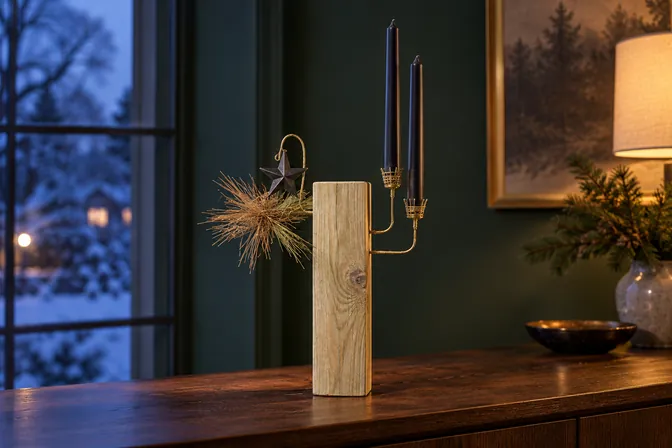
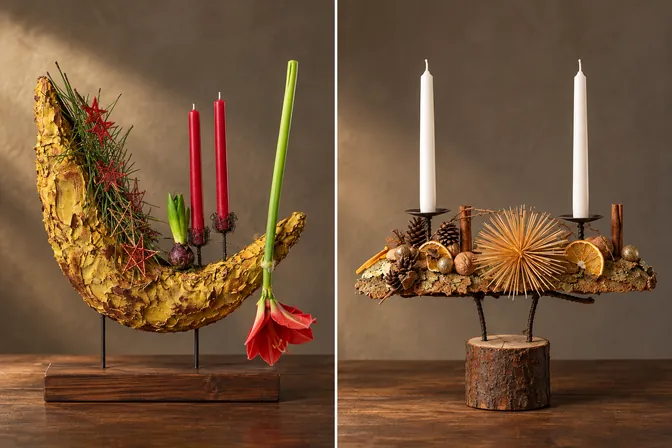
The wooden candleholder carries slender candles to the side on curved wire stems with woven cups. On the other side, a small open ornament combines wire, pine needles, and a star. The block remains visible, its grain beside the fine lines. Choose this direction if you like wood and want a small amount of plant decoration. You will weave the holders and install them in the wooden base before adding the decoration.
The upright apple-branch wreath creates a tall accent with an open circle on its own stand. It occupies a separate position in the room and reads differently from a wreath lying on a table. Its two side candles are decorative only. Do not light them. The wreath selection guide gives the fuller comparison with other wreath shapes; here the stand is what changes its role in an interior.
A raised ring, crescent, or textured platform
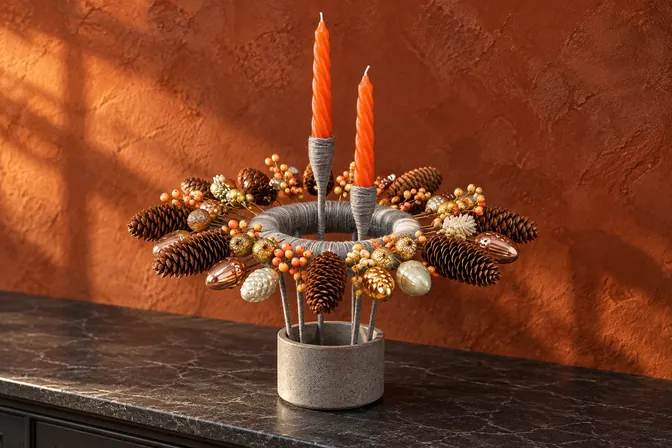
In the gray-and-orange candleholder, the ring sits horizontally above a container. Wire supports hold it up, and wool wrapping connects the ring and uprights through color. Cones and small ornaments follow its circumference; two orange candles stand at different heights in the center. The ring belongs to a tall object on its own supports.
The crescent with stars rises on legs above a wooden base. The shape is cut from polystyrene, textured with plaster, colored, and finished with bronze wax on the raised areas. Candle cups, stars, and hanging details follow after the form itself is complete. Choose this project if you enjoy making a sculptural form and finishing its surface before adding decorations.
The stump arrangement has a raised platform covered in cork that resembles bark. A gold-colored spiky sphere made from toothpicks draws attention, beside nuts, citrus, cinnamon, and a larch branch. It suits someone interested in texture and constructing objects by hand. The platform and candle holders need separate installation; it is more involved than gluing decorations onto a ready-made base.
These raised forms have different outlines even before their decorations are added. The horizontal ring keeps the center open, the crescent has an upward curve, and the cork-covered platform creates a surface for the focal ornament. Compare those bare shapes with the space you have available.
A living plant instead of cut flowers
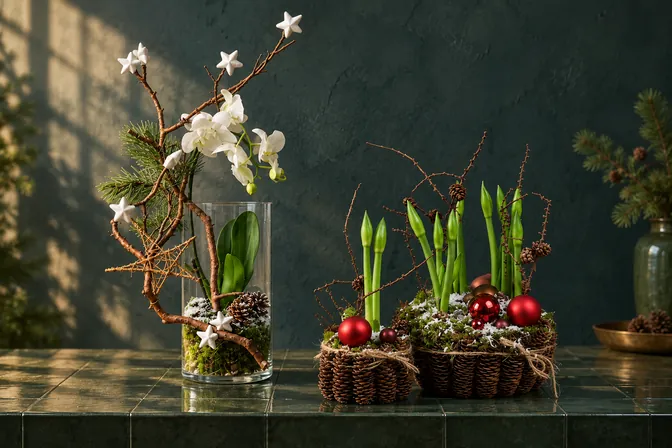
The phalaenopsis arrangement in a glass vase keeps the orchid in its own pot. Moss hides that pot inside the outer vessel. Two pieces of pine branchwork run inside and outside the glass, connecting the tall flower stem with the space around it. Cones, small stars, and winter decorations complete the setting.
Choose this idea when the object you want to decorate is a potted orchid. The vase needs to fit the particular plant, and the decoration should leave access for care. Consider those conditions before assembling it. Glass and moss do not establish one watering routine for every orchid or room.
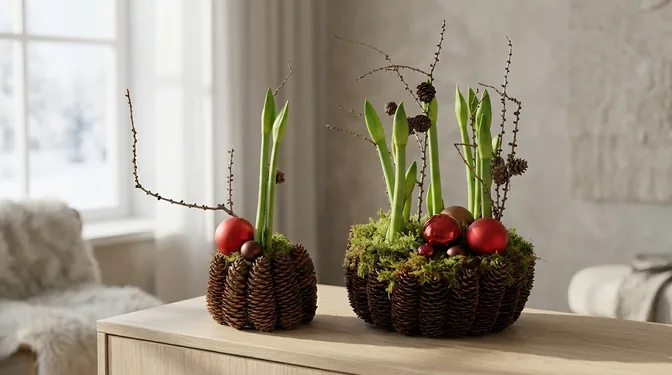
In the amaryllis planter project, living bulbs are planted in soil. Split spruce cones cover the outside of the container, moss covers the soil surface, and ornaments and larch branches repeat the plant's colors and lines. The cone-covered sides make the container part of the Christmas decoration. A smaller and a larger version provide two scales to consider for a gift or a place at home.
The separate amaryllis planter guide covers the container and planting in detail. Our Christmas Amaryllis Planters with Pinecone Cladding video follows this exact project, including the cone-covered container and placement of the plants. It is a useful continuation if you want to see how the outside finish and planted arrangement come together.
Prepare for the construction you have chosen
Pick one structure before buying a collection of decorations. Fresh flowers in wet floral foam need a suitable vessel, a way to hold the foam, and a liner when the container is not watertight. The open board needs uprights and water tubes. A wooden candleholder or crescent begins with building the object itself. A potted plant needs continued access for care as the decoration goes around it.
Candles can establish height and color. Their attachments alongside wood, wool, greenery, and dried decorations should not be treated as a ready-made solution for an open flame. For a light effect, you could consider flameless candles. Check their size and attachment against the chosen construction. The apple-branch wreath's side candles remain unlit decoration.
Set some ornaments aside while you compare the main materials with the room. Add the small details once the outline reads clearly, the intended texture shows, and there is space around the piece. If the shape is already getting lost, adjust it before adding more decoration.