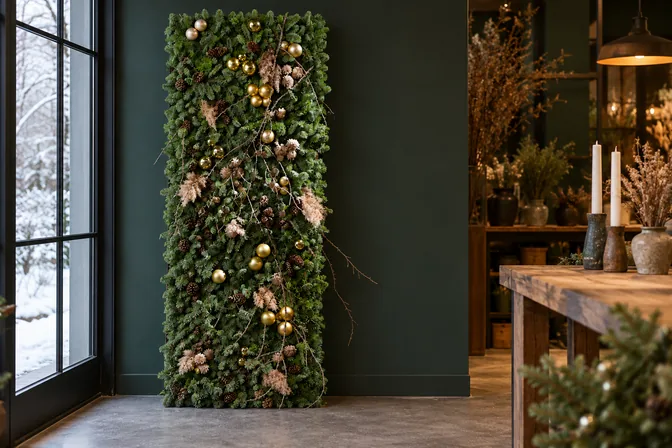
Choose an evergreen line for a long rail or beam, a panel or star for a free wall, and a tall tree form for a separate position in the room. A console can hold a branch arrangement between vessels. Each design needs its own support. Choose the place and structure before the greenery and decorations.
Large decorations need to read from a distance. The outline and larger groups of color show first, followed by individual cones and fine branches. Before assembling anything, step back to the place from which you will usually see it. Decide whether the space calls for a long strip, a broad surface, or a tall vertical shape.
Match the shape to the available space
Place and purpose | A form to consider | What to plan first |
|---|---|---|
Long beam, rail, or display edge | Flat garland or fuller evergreen wrapping | Length, visible sides, and attachment to the location |
Free surface at an entrance or in a display | Broad evergreen panel | Overall outline, side edges, and large accents |
Wall needing a clear silhouette | Five-pointed branch star | Size and space around the points |
Separate part of a room | Tall tree on a base | Height, lower branch spread, and viewing directions |
Console or decorative shelf | Branch arrangement on two vessels | Surface depth and room for trailing details |
The structure within a decoration and its attachment to a wall, rail, or facade do different jobs. A completed garland still needs a suitable installation at the chosen location. Plan that attachment for the actual surface and finished object; a wire connection inside the garland does not settle it.
Garlands: a flexible line or greenery around a support
The large-evergreen project explores several ways to build a form. A flatter garland grows from overlapping bundles, with each new section wired to the previous one. Larch branches and reeds add looser lines alongside the evergreen foliage.
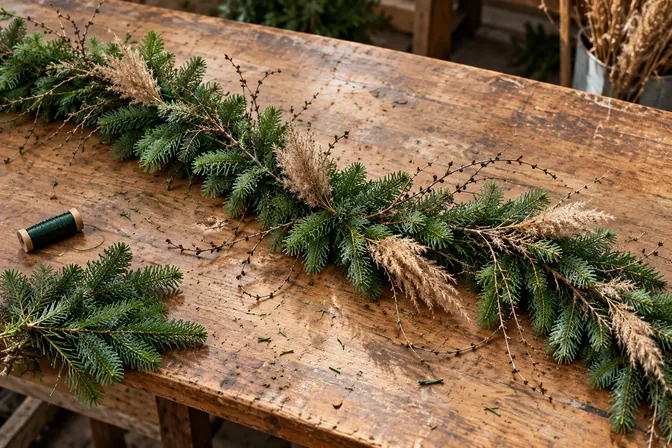
For a fuller strip, the greenery wraps around a separate support. A garland built around a wooden strip differs from the flexible bundle construction. A reinforced tubular base allows another, bulkier form. The support sets much of the line's thickness and character. Choose it together with the location, before preparing all the foliage.
The same project also demonstrates a large panel. Joined polystyrene sheets receive evergreen branches held with wire pins. Large sections cover the surface first; smaller sprigs fill exposed patches and finish the edges. Ornaments and cones sit in groups, with larch branches crossing the surface. A panel provides a broad area for color, while a garland carries the eye along a line.
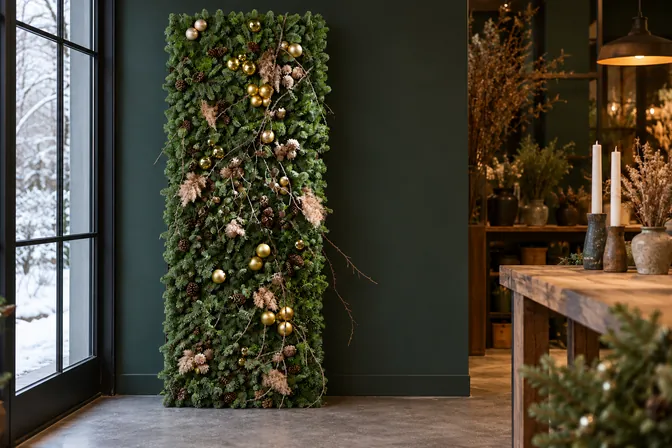
Compare the flexible line, wrapped support, and broad panel before choosing a construction. Allow space to work on a large base horizontally and then view it upright. A design that appears evenly filled from above can reveal gaps and unfinished side edges when raised into its intended position.
Two tree structures for a tall feature
The tall evergreen tree uses a wooden base and central metal rod. Wire support widens the first layer so that the branches spread away from the center. Greenery rises in layers, while short, dry willow pieces are linked into small garland strands for the upper part of the tree.
The twig garlands finish the upper part of a tree held by its own base and central rod. Consider this direction if you want a full evergreen vertical form with a separate pattern of small branches.

The large interior branch tree starts with a different framework. Wires around a central rod interlace into a mesh, wider at the bottom, which carries larch branches. Red ornaments hang at varying heights and berry branches pass through the interior. The spreading branch lines remain visible, with gaps between them.

Choose between a dense green surface and a more open branch pattern. In either case, allow for the lower spread rather than measuring height alone. Increasing the size means reconsidering the base and support; the appearance of a smaller design is not a tested specification for a larger one.
A wall star needs a readable outline
The branch star gives a wall a distinct silhouette rather than a broad filled surface. Five main branches establish the points. Inner crosspieces provide places to secure pine and decorations while keeping the filling within the outline. Red ornaments, small garlands, cones, and felt-covered ends repeat its direction.

Step back from the bare frame before decorating it. If the star is already hard to recognize, adding more ornaments will not clarify it. Preserve the direction of the points and the gaps as the greenery goes in. The separate Christmas twig star guide covers the construction and decoration in detail.
Choose the star when you want a recognizable shape surrounded by clear wall space. A panel has more room for broad groups of color; the star asks you to keep its points visible. Compare the two outlines against the place you have chosen before gathering the decorations.
A branch feature for a console or decorative shelf
The interior arrangement on two tall vessels creates length without a continuous mass of foliage. Branches connect the supports, greenery and ornaments can trail below, and a flower has its own water tube. The vessels remain visible parts of the design.

Consider this approach when you want open spaces between the details. Check that both vessels fit the surface, where the branches extend, and what will hang below the edge. A mantel setting is a decorative location, not proof that the arrangement is suitable beside a working fire. Candles and plant materials in the design do not establish a safe-burning setup.
Once you have a place, choose one main outline. Start with the garland structure for a long line, compare the panel and star for a wall, or choose a full or open tree for height. The Christmas and winter floristry collection offers other forms for the home. Select the smaller decorations once the outline and support are clear.