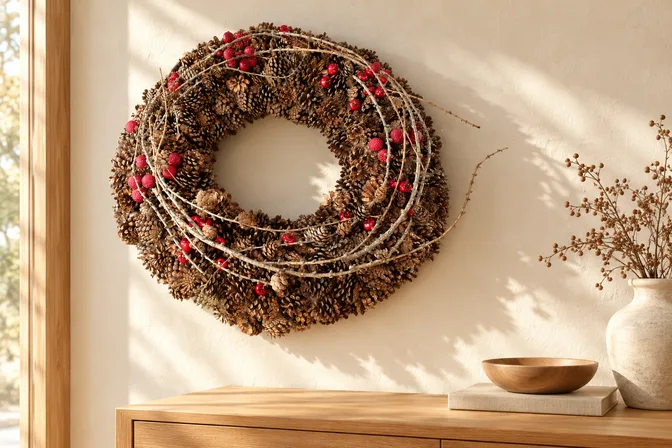
A ring of pinecones has a solid, knobbly outline. A wreath of bare branches lets the wall show through. Those different silhouettes begin with the base, before the first decoration goes on. For a full ring with wired details pushed into its body, consider a firmly bound hay base. For a visible web of curved twigs, let branches form the wreath itself. Choose a separate wire frame when you want to set the outline first and attach the branches to it.
A full evergreen wreath with pinecones and gold ornaments.
Decide how much of the foundation you want to see. A full ring and a few airy branches need different fixings, even if both carry pinecones.
Match the base to the look
- For a rounded body beneath greenery or pinecones, consider firmly bound hay or dry grass. Wrap greenery around it or insert prepared cone wires. Plan how to finish gaps and the back.
- For an open circle with visible twigs, overlap naturally curved branches and bind the joins with wire. The joints and spare ends remain part of the visible work.
- For a deliberate outline with branches arranged over it, use a separate wire frame. Attach branches at more than one point, and plan the frame assembly and mounting.
Match the fixing to the decoration and the way the wreath will be displayed. Holding one small dry detail does not establish how a base will behave with a different load.
Hay gives a full wreath its body
A firmly bound hay ring provides a rounded body to wrap around and a place for individual wire fixings to enter. In a pinecone wreath, wire goes around each cone near its lower scales. The two ends twist together and go into the hay ring. Each cone has its own wire fixing.
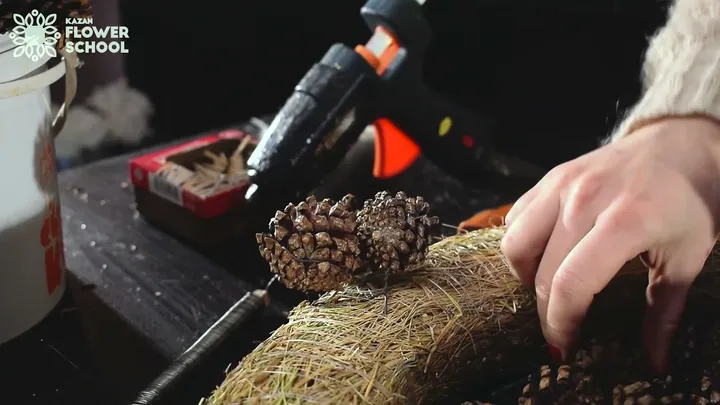
Look between the cones as well as across their tops. A pale patch of hay can interrupt the dark, textured surface. Small pieces of felt tucked into the gaps can conceal the base without forcing in another cone. Allow for those gaps when you choose what will cover the base. For a closer look at forming and placing those individual fixings, the Natural Pinecone Christmas Wreath video follows the cones from preparation to the finished surface.
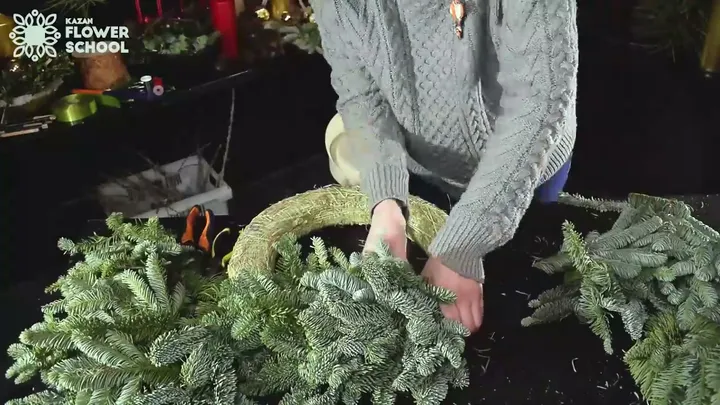
Evergreen branches use the same kind of body differently. Lay small groups around the ring, bind them with continuous spool wire and overlap the next group over the previous fixing. Keep the tips moving in a consistent direction. At the join, ease the final groups under the first so the circle continues without an obvious stop. The back is another surface to finish; felt or a similar dense fabric can cover the exposed base.
A hay base does not always have to disappear. A grass wreath can leave some of it exposed as part of the texture. Decide which areas should show before you start covering them. Here, hay means dry grass, as used in these examples. A shop's straw form is a different material description; check what the actual form is made from instead of treating the names as interchangeable.
If you make the hay ring yourself, wrap the grass into a firm length, curve it into a circle, overlap the ends and bind the joined ring again. Add grass where the body is uneven. Check that it holds its shape before decoration, then trim loose strands. The thickness follows the project you want to make; a size from another wreath is not a rule for yours.
For the movement of overlapping the greenery and closing the join, continue with the Classic Fir Christmas Wreath video.
Branches can be the visible foundation
Choose a branch base when you want the spaces between the twigs to remain part of the wreath. A curved branch starts the line of the circle. The next overlaps it and continues that line. Bind the overlap in two places, then add the next branch. A stiff, straight section that fights the curve may need trimming rather than more force.
Build the first circle before adding volume. Put it down and look at the whole outline. Where does a straight section flatten the ring? Where do too many side shoots hide the opening? Add a curved branch to correct the first problem; trim or reposition the extra shoots for the second. You can build outward and inward while keeping gaps between the branches.
The open gaps leave the fixings visible too. Clip spare wire and press the cut ends back against the branches as you go. Small twists are easier to hide than long tails left until the end. An added ornament also needs a deliberate attachment to a suitable branch; the twig network is not a solid surface into which you can push a hay-ring fixing.
A wire frame sets the shape separately
Wire used to bind a bundle is not the same thing as a wire frame. Flexible spool wire ties materials together. A frame has its own shaped structure to which those materials attach.
One open design uses a large ring and a smaller ring, shifted away from the center, with wire crosspieces connecting them. Apple branches cover and cross that structure. Their tips can reach inward or outward without having to create the main circle by themselves. Fasten a branch in at least two places so that a single tie does not become its pivot.
Consider this frame for an offset opening and branches whose positions you want to control. It also adds assembly work. In the standing version, the frame attaches to metal supports in a wooden base. That mounting belongs to the complete design; copying the ring alone does not create a stable standing wreath. If you want a simple hanging circle, the visible branch construction may give you the line you want with fewer separate parts.
Check the base before you cover it
Put the undecorated circle where you can see its outline. Check the overlaps and joins for movement before you hide them. Decide which side faces the room, how much of the back will show and where the hanging or standing support belongs. Trim and tuck cut wire ends while you can still reach them.
Keep the material names specific when you shop. A polystyrene ring and floral foam are different products; floral foam itself comes in types for different uses. Do not transfer an insertion or binding method to another product merely because both forms are round. For these three constructions, start with the outline you want to see: a full body, an open branch circle or branches arranged on a frame. Then choose the decoration and its fixing together.
If you are choosing between the finished textures, compare evergreen and pinecone wreaths. For more seasonal ideas, explore Christmas and winter floristry.