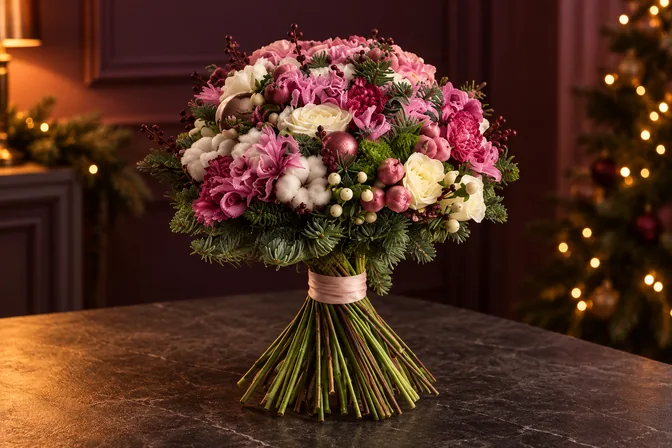
A Christmas bouquet can be a rounded handful of flowers and fir, an open design edged with cones, or a star with a structure of its own. Choose the outline first. It determines where the flowers sit, how much space the bouquet takes up and whether you need to make a separate frame before arranging a single stem.
For a gift, picture the bouquet in someone's hands as well as in a vase. A broad frame and a compact collar can hold similar flowers yet feel quite different. The seven designs below range from a soft fir dome to a double wire star, each with a different way of supporting the flowers.
What a bouquet frame does
A frame, sometimes called an armature, supports the arrangement and gives stems separate spaces. Wire cells keep the flowers from sliding toward the middle; a border establishes the outer shape. Some frames have a wire handle. Others rely on the flower stems themselves to form the handle, which makes the first stage of assembly more demanding.
The look you want | A design to consider | The main constraint |
|---|---|---|
A familiar gift bouquet with greenery | Rounded fir bouquet | Keep the dome even as you add stems |
An open winter outline | Cones spaced around a wire frame | Leave room between the materials |
A contained shape with a natural border | Close-set cone collar | Keep most flowers inside the edge |
A clear five-pointed outline | Twig star covered with fir | Leave the star points visible |
A sculptural shape with depth | Two wire stars joined together | There is no separate frame handle |
A circular outline with ornaments | Wire ring on a handle | Keep the decorated rim visible |
A handheld wreath shape | Two concentric wire rings | Strong flower stems form the first support |
A rounded bouquet with fir and cotton
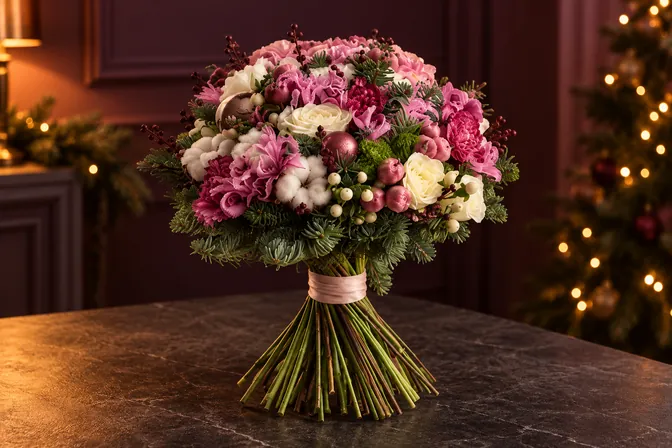
The rounded design combines fir greenery, cotton, flowers and small ornaments in a dome. The first flowers establish the highest point; subsequent stems sit lower toward the edge. Fir passes between the flowers and finishes the lower perimeter as a collar of greenery.
The small fir pieces are prepared on wooden skewers with floral tape before assembly. Cotton and decorative apples are prepared separately too. Ornaments and apples go in toward the end, when the remaining spaces are visible.
Rather than a single dominant focal flower, this bouquet has white, pink and berry accents distributed around it. Airy flowers rise a little above the denser material. Choose this shape if you want the flowers to be visible from all sides. The part that needs attention is the dome: turn the bouquet in your hand as you work so one side does not gradually become taller than the other.
Two cone frames: open or close-fitting
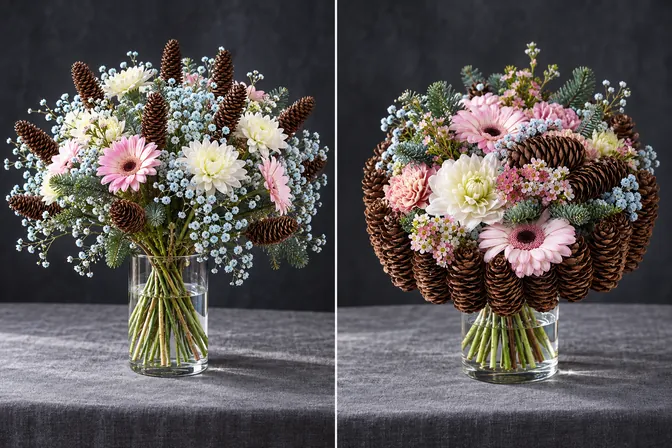
Cones spaced through an open frame
In the first cone design, elongated spruce cones sit on wire ends pointing in different directions. The lower wires form a mesh, while the upper wires spread the cones around the volume. The cones remain separate rather than forming a solid wall.
Dyed blue baby's breath and pale gerberas create a cool winter palette. Fir greenery fills the lower area, and fine branching sprigs add a delicate texture. As the flowers go in, much of the wire disappears, leaving the individual cones visible around the edge.
This is a useful option when you want an open outline. Leave some gaps. Filling them all with flowers would hide the spaces that give the design its character. A wide frame does not need to become a dense ball.
A compact bouquet inside a cone collar
The second design connects spruce cones into a close-set fence. Two rows of wire pass beneath their scales. The bases of the cones line up, and a separate wire handle attaches beneath the center of the circular collar.
Most of the flowers stay within that boundary. Fir, baby's breath, gerberas and fine branching sprigs appear again, with dahlia and carnations added to the filling. Two gerberas sit together and a third sits to one side. Two further cones lie almost horizontally among the flowers.
The result has a much more contained outline, despite sharing much of its plant material with the open design. Choose it for the defined natural edge. Select cones of similar height with scales that hold together; crumbly cones are awkward to bind. The weight of the collar also needs a suitable support beneath it.
Two ways to make a star bouquet
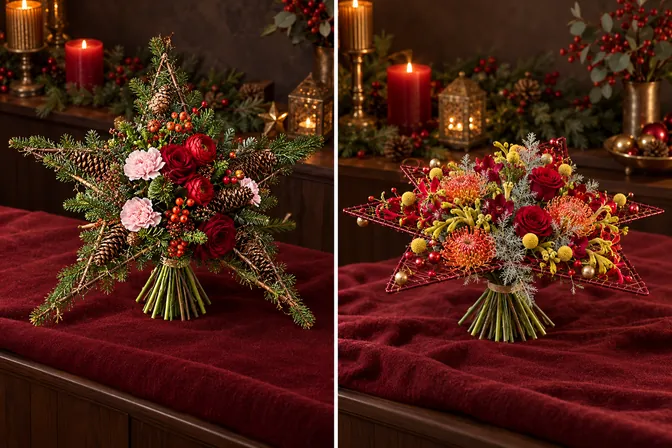
A twig star with a fir-covered outline
Five straight twigs of equal length form a five-pointed star, secured at their intersections. Fine decorative wire makes a mesh over the points, and small pieces of fir greenery are bound onto it. Split cones add texture without projecting as far as whole cones would.
A separate wire handle and an internal mesh support the flowers. Red and burgundy blooms, orange rose hips and small berry accents fill the center. Keep checking the outline from above: greenery crossing a point can quickly make the star difficult to recognize.
Choose this design for a strong silhouette. The trade-off is restraint in the filling. A generous branch that suits a round bouquet may cover an entire star point here.
Two wire stars with flowers between them
The other star joins two wire outlines of different sizes with connecting pieces. Fine wire woven through the gaps adds support. Wool yarn softens the wire lines, and small ornaments, decorative apples and snowflakes sit with space around them.
This frame has no separate handle. Firm flower stems go through it first and then gather into a spiral beneath the flowers. A table edge can support the frame while those first stems are positioned, or another person can help hold it.
Roses and textural accent blooms bring different flower sizes to the red, orange and yellow palette. White asparagus foliage echoes the small white decorations. The side view matters here: the space between the two stars gives the flowers depth. Choose it if making the structure appeals to you, and allow for that preparation before you start arranging.
An ornament ring and a wreath bouquet are different builds
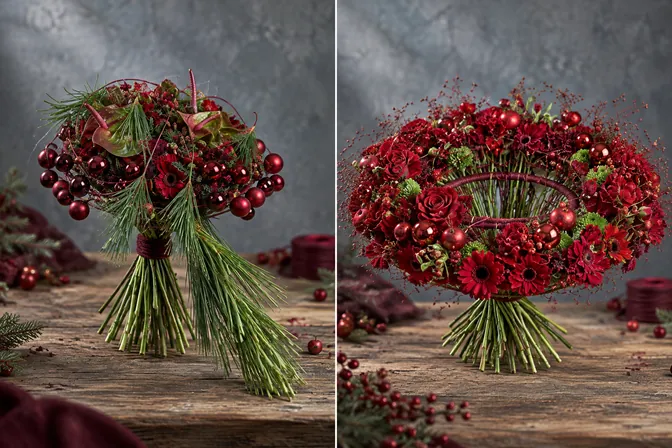
An ornament ring with its own handle
This frame has a handle, radiating wire supports and an internal web. A separate outer ring is wrapped in yarn to match the ornaments attached around it. The rim remains part of the visible design.
Clustered carnations and decorative apples provide the main filling. Two anthuriums form one off-center group, while a thinned pine branch curves downward. The rounded flower mass, smooth ornaments and trailing evergreen line each have a distinct role.
Do not bury the decorated ring beneath tall flowers. The anthuriums create a clear accent; substituting another large flower means checking its scale against the ring again. The frame already provides a strong border, so the filling needs room to sit within it.
A wreath bouquet supported by its flower stems
This design starts with two concentric aluminum rings wrapped in yarn. Frequent cross wires connect them. Extra cells along the inner and outer edges let flowers sit at different levels, rather than in a single flat line. Plastic ornaments are wired around their necks, with glossy and matte surfaces distributed around the frame.
The flower stems support the frame. Spray roses with firm stems are positioned around it first, then gathered into a spiral centered beneath the bouquet. Other flowers and more delicate branching material are added after that first support is established. Soft stems alone are a poor starting point for this construction.
Compared with the handled ornament ring, the early flower placement takes more care: those stems are both the filling and the support. A smaller diameter offers a more compact starting point while keeping the same basic construction.
Before you give the bouquet
Look from above and from the side. Can you still see the star, ring or cone collar you chose? Is the binding centered beneath the arrangement? Check the ornaments individually, tuck away projecting wire ends and choose shatter-resistant ornaments for these wired designs.
Choose wrapping after you can see the finished outline. A wide paper collar may hide precisely the feature that made you choose a star or wreath bouquet. Keep the outline visible and let the flowers and structure carry the gift.
If you are still deciding, return to the border: soft fir for a classic dome, separate cones for an open winter design, or a close-set cone collar for a contained shape. For a more sculptural bouquet, compare the twig star, double star and wreath before buying materials. Browse more Christmas and winter flower arranging ideas when you want a different shape or material to explore.